
 By Abdullah Bajwa
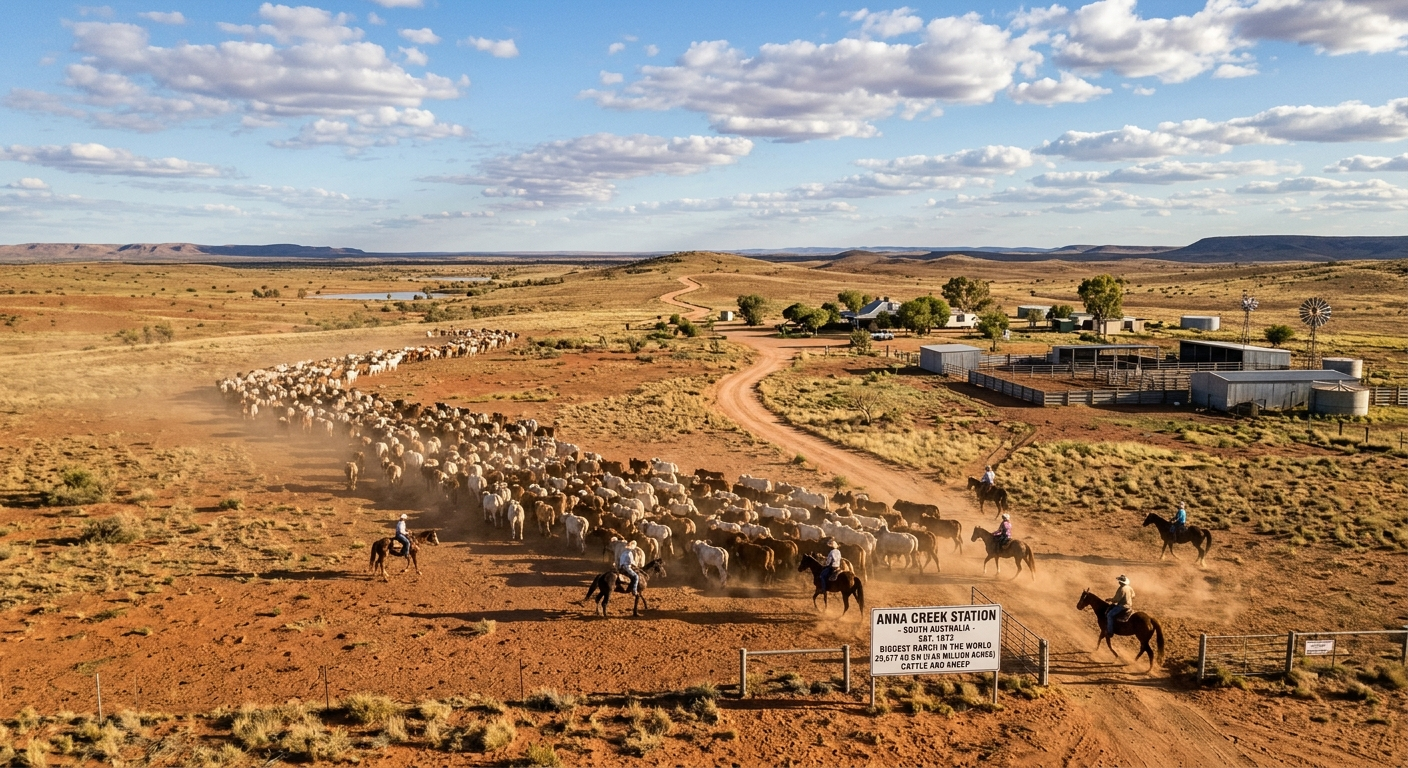
When people think about ranches, they often picture endless green pastures, cowboys riding horses, and thousands of cattle moving across open land. But what if a single ranch was so enormous that it covered more land than some entire countries? That’s exactly what makes the biggest ranch in the world so fascinating.
Located in South Australia, Anna Creek Station holds the title of the world’s largest working cattle station. Its incredible size, challenging landscape, and long history make it one of the most remarkable agricultural properties on the planet.
Let’s take a closer look at this massive property and what makes it so special.
Where Is the Biggest Ranch in the World?
The biggest ranch in the world, Anna Creek Station, is located in the remote outback of South Australia. It’s situated in a dry, isolated region where open landscapes, limited rainfall, and extreme temperatures are part of everyday life.
Unlike smaller farms that operate close to towns and major roads, Anna Creek is surrounded by vast stretches of countryside. The small settlement of William Creek is located within the station’s boundaries, while Coober Pedy is an important nearby town for supplies and transportation.
The property is particularly interesting because its enormous size doesn’t come with lush green fields. Instead, it operates in a challenging environment where managing livestock requires careful planning and considerable experience.
How Big Is Anna Creek Station?
Here’s where things get impressive.
Anna Creek Station covers approximately 23,677 square kilometers, equivalent to around 5.85 million acres. That’s an extraordinary amount of land for a single working cattle property.
To put its size into perspective, consider these figures:
- Approximately 23,677 square kilometers of land.
- Around 5.85 million acres in total.
- Larger than the country of Israel.
- More than seven times the size of America’s famous King Ranch in Texas.
It’s difficult to imagine managing a property of this scale. Even traveling from one section to another can take considerable time.
Anna Creek Station: Key Facts at a Glance
| Feature | Details |
|---|---|
| Name | Anna Creek Station |
| Location | South Australia, Australia |
| Land area | Approximately 23,677 km² |
| Size in acres | Around 5.85 million acres |
| Main business | Cattle production |
| Established | 1863 |
| Current ownership | Williams family |
| Record | World’s largest working cattle station |
A Brief History of Anna Creek Station
Anna Creek Station has a history dating back to 1863. Like many large Australian pastoral properties, it was originally established for livestock production during the expansion of the country’s agricultural industry.
Interestingly, the property initially focused on sheep farming. However, the conditions weren’t always suitable for sheep, particularly because of problems caused by wild dingoes.
Over time, cattle became the main focus of the operation.
For many years, Anna Creek was associated with S. Kidman & Co., a major Australian pastoral business founded by Sir Sidney Kidman. The company became famous for building an enormous network of cattle stations across Australia.
In 2016, the Williams family, an established South Australian farming family, acquired Anna Creek Station and its associated property, The Peake.
The change in ownership marked an important chapter in the station’s history.
What Is Ranch Life Like on Such a Huge Property?
Running the biggest ranch in the world isn’t simply about having plenty of land. It involves managing animals, water supplies, workers, equipment, and transportation across an enormous area.
The dry Australian outback creates several challenges for livestock management.
Some important parts of daily operations include:
- Cattle management: Staff must monitor livestock and ensure animals remain healthy.
- Water supplies: Reliable water sources are essential in a region with limited rainfall.
- Transportation: Moving workers, equipment, and cattle across large distances requires careful planning.
- Animal monitoring: Aircraft and other modern equipment can help locate livestock across remote areas.
- Land management: Maintaining grazing conditions is important for long-term agricultural production.
And there’s another interesting point: technology has changed how large cattle stations operate. Activities that once depended heavily on horseback stockmen can now involve motorbikes, vehicles, and aircraft.
How Does Anna Creek Compare With King Ranch?
Many people searching for the biggest ranch in the world have probably heard of King Ranch in Texas, United States.
King Ranch is one of America’s most famous ranches and is known for its significant contribution to cattle breeding and agricultural history.
However, Anna Creek is considerably larger.
| Ranch | Location | Approximate Size |
|---|---|---|
| Anna Creek Station | South Australia | 5.85 million acres |
| King Ranch | Texas, USA | 825,000 acres |
Anna Creek is more than seven times larger by land area. That’s a huge difference, even when comparing two properties with internationally recognized agricultural reputations.
Why Is Anna Creek Station So Famous?
Its record-breaking size is the biggest reason for its international recognition. But there’s more to the story.
Anna Creek represents the scale of Australia’s cattle industry and demonstrates how agricultural businesses can operate in extremely remote environments.
Its history, livestock operations, and unusual landscape attract interest from farming enthusiasts, researchers, and people simply curious about enormous properties.
Final Thoughts
The biggest ranch in the world is an impressive example of how far agriculture can extend across challenging landscapes. With approximately 5.85 million acres, Anna Creek Station is much more than an ordinary cattle property.
From its beginnings in the nineteenth century to its modern livestock operations, it has maintained an important place in Australia’s agricultural history. And although its size is difficult to imagine, its real achievement is making cattle production work across such a vast and demanding environment.